Monday, November 12, 2012

Dinner Party

Tea After Dinner in the Salon: Sunday (Nov. 11), Mike and I had Nazli Rizk and Nahla and Nagy Fathy over for dinner. Dinner was catered from Abou Shakra, a chain with the branch near us being the oldest in Cairo. We had assorted dolmas, pasta with chicken, vine leaves, mixed grill (kofta, kebab, shish tawouk), stuffed pigeon, tropical chicken grill, and bread. Following the main course, we had a break for tea and talk to let our dinner settle before we had dessert. Nahla related how Muslims and Christians lived amicably side-by-side in her childhood neighborhood of Shubra. When the wife of a Christian neighbor became ill, Nahla's mother nursed her baby. She also recounted that, when she reported her car stolen at the local police station just a couple days after January 1 (2012), it was already listed as record number 89 in the suburb of New Maadi, where she and Nagy live. Nazli mentioned that her father had a close friend from the Muslim Brotherhood; and he visited the friend and offered assistance even while his colleague was imprisoned. Their two families went on vacation together at El Cabanon, when he was eventually freed. Nazli (14 yr. at the time) was very good friends with the youngest daughter (5 yr. old), who couldn't understand how serious a situation Nazli's quickly sinking knee-deep into a muddy area was. Nazli was finally able to free herself. She also mentioned that she thought the country was turning more inward compared to the era of her school days (1950s-60s), when Egypt seemed open to modernization. Our guests outshone us in the area of after dinner sweets. While we offered ice cream, Nazli brought a homemade cocoa cake of wonderful moistness. Nahla and Nagy provided a huge tray of Middle Eastern delicacies from an oriental bakery chain, La Reine. They were superb. We were kept busy sampling all of the varieties. The meal indeed turned into quite a feast.
Legend behind Um 'Ali: Nagy related the story behind the famous Egyptian dessert, Um 'Ali. Legend has it that Um 'Ali was the first wife of the Sultan Ezz El Din Aybek. In Egypt, women were not allowed to rule but were permitted to be guardians to their sons, who would become king when they came of age. When the sultan died, his second wife had a dispute with Um 'Ali over whose son would be the successor to the sultan. The second wife was heavily guarded making it difficult for Um 'Ali to dispose of her. Um 'Ali hatched a plot bribing the second wife’s handmaids. While the second wife went to the hammam for a bath, she was beaten to death, by the slippers of her own handmaids! To celebrate her death, Um 'Ali made this dessert and distributed it among the people of the land. Struggles for succession could be treacherous in periods of Egyptian history. Mike and I enjoyed a great evening visiting with and getting to know our friends.
Mike and Nagy playing chess.

Saturday, November 10, 2012

Women: How Holy Would you be in Egypt?

Women Judged by How They Look: A female columnist for Daily News Egypt, Adel Heine, was told by Facebook that she was pleasant to Satan. Read the following to find out what accompanied it and her interpretation. "The way this sad truth was brought to my attention was accompanied by a drawing that showed eight different women wearing different styles of clothes, from shorts and a crop top to full galabeya and a long veil covering hair and shoulders. The woman in the beach wear is allocated the number one and as the numbers go up, the length of the clothes increases as do the steps the female figurines are standing on. Number eight looms high over her sisters, lording her righteousness over all and sundry." Numbers Two and Three: "Looking closely at the depictions poses some interesting observations. While it is obvious why number two is low on the totem pole, she is clad in a t-shirt and wears Capri pants, her neighbour is dressed in what would be considered demure in most areas of the world; a long sleeved shirt and long pants, yet she is still only ranked third in the row of shame." Next: "Four and five are nearly twins, with both covering their hair, yet five wins by covering her neck as well." Number Six: "Six scored her points undoubtedly by wearing a shirt over her pants that reaches hip height and her veil covers the top of her chest, yet her arms are still fully visible." Seven and Eight: "Seven covers shoulders and wears a thigh hugging shirt and probably only lost to eight because of her galabeya. A friend remarked that number nine and ten do not appear because of course they stayed home. I bet you they are wearing whatever they want. Strangely enough, it is not until we get to number seven that the clothes stop being skin tight. I have never understood how the desire for modesty goes hand in hand with bra-strap showing shirts and panty lines visible through pants."Holier than Thou: "Whoever drew the picture has done us all a big service by finally putting the age old question of who is holier than thou to rest. And now we know as well that as long as hair and neck are out of sight you can wear clothes that require a shoehorn to get into in the morning and you still are considered to be over the halfway mark of proper dress (http://dailynewsegypt.com/2012/11/08/judging-a-woman-by-her-cover)." Getting Harder to be a Woman in Egypt: I guess I should have known it would be this hard. Aside from a Muslim Fulbright professor at Cairo University, I have not been welcomed that much at the university. I thought perhaps it was because I'm on the quiet side. Rather, it's a prevailing attitude on women's role. The rise of the Muslim Brotherhood to power in Egypt has brought with it a new group of female politicians who say they are determined to bring more women into leadership roles — and at the same time want to consecrate a deeply conservative Islamic vision for women in Egypt. It's definitely arrived.

Friday, November 9, 2012

Luxorالأقصر

Overnight Train to Luxor: For $60.00 each complete with dinner, Mike and I took the overnight train to Luxor. It takes 10 hours. The name Luxor comes from the Arabic al-quṣūr (القصور), literally. "the palaces," which is what the invading Arabs called the monuments when they conquered the area. Luxor was the ancient city of Thebes, the great capital of Egypt during the New Kingdom (1292-1069 BC), and the splendid city of the god Amun-Ra. The New Kingdom is also known as the Ramesid period, after the eleven pharaohs that took the name of Ramses.
Second Time for Me: This was my second trip to Luxor and the Valley of the Kings–but after 43 years. The first time I had been with a student group from the American University in Cairo, where I was studying Arabic. The temperature in Luxor is always about 10° hotter than that in Cairo. However, the second day following our arrival, the region got cloud cover and about two hours of rain. It was interesting to hear my tour guide warn me of the hazardous conditions on the roads and to listen to people talk about how cold it was. It was fascinating to see the countryside change from the congestion, pollution, and traffic of Cairo to a slower pace with donkeys as a major means of transportation, many irrigation canals, and green vegetable, sugar cane, and banana fields. For tourists, it's a great time to visit. Following the 2011 Arab spring, tourism to Egypt has dropped significantly. To make up for the downturn in income, many locals grow their own food. Their diet includes goat cheese, pigeons, subsidized and homebaked bread, and home-grown tomatoes. For tourists, there are still too many hyper and aggressive salesmen (most are men). Vendors from tour guides to taxi and horse and carriage drivers can be real pests.
Contrasts in Style: I wonder how much Mike and I confuse people. Mike can blend in and be taken for an Egyptian. The picture shows how much he even resembles the Egyptian president, Muhammad Morsi. I, on the other hand, have blond hair and wear slacks with no hijab (head covering), so definitely stand out. Shop owners in all of Egypt often display their religious affilation. Muslims may wear a white prayer cap, display plaques of Qur'anic verses written in calligraphy, or have a straggly or fuller beard. Christians have pictures of Christ or important Coptic or Greek Orthodox saints. A river front restaurant we visited, Al Kebabgy, had a rack of books on discovering Islam in various languages. Groups of feluccas were tied up only a few yards away. What we lost in sophistication, we gained in location. We got to eat in the open, paying quite a bit to be on the Nile. Service was on the slow side. Yet, since we were eating outdoors on the Nile, we weren't in a hurry.
Dendera: On our first day of sightseeing, Mike ferried across the Nile and set off for Deir al-Medina, home to the artisans who worked on the tombs in the Valley of the Kings. Since seeing a display of the treasures of King Tut's tomb in Chicago, Mike has been fascinated by Howard Carter's discovery of the Tomb of Tutankhamun in 1922 and the culture it represents. He has even learned a lot of hieroglyphics. He wanted to enter the Valley in the same manner as the workers who constructed the tombs. I took off for a Ptolemaic temple of the Graeco-Roman period dedicated to the goddess of love, Hathor. This scene depicts Cleopatra and her son Caesarion, the only temple in Egypt to portray the famous queen and her son. Hathor is commonly depicted as a cow goddess with head horns in which is set a sun disk with a stylized, upright form of an Egyptian cobra. My guide was a Coptic Christian named Michael. We stopped for some of the small round loaves of bread baked by Coptic churches for distribution for those in need during the week. It is leavened bread, and each cake is about three inches in diameter and one inch in thickness. The same type of bread when used for communion must always be freshly baked on church premises on the morning of the Mass. Every church has its own little bake-house where the bread, made from the finest flour, is carefully prepared on Sunday morning, and stamped with a device of crosses.
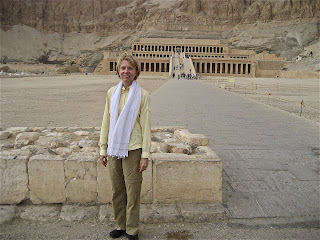
Valley of the Kings (Wadi al-Muluk): Mike again set out on his carefully researched approach to the Valley of the Kings; and I met up with him later at the Tomb of King Tutankhamen. I first visited the Colossi of Memnon, two massive stone statues of Pharaoh Amenhotep III. The original function of the Colossi was to stand guard at the entrance to his temple. Then I visited the mortuary temple of Queen Hatshepsut, (also known as Deir al-Bahri [Northern Monastery]). She was the fifth pharaoh of the 18th dynasty and is regarded as one of the most successful pharaohs, reigning 22 years. In the Valley of the Kings, I entered three tombs before that of King Tut–Ramses IV, Ramses IX, and Ramses III (considered to be the last great New Kingdom king to wield any substantial authority over Egypt). No pictures are allowed in the Valley of the Kings.
The Tomb of Tutankhamun: Finally, I met Mike and we entered the tomb together. Since Mike had read about and studied the expanse so long, this was the culmination of an emotional journey. Although all of the precious artifacts have been removed, King Tutankhamun's mummy and one of the nesting coffins in an open sarcophagus still rests in his tomb. The western wall is covered with 12 baboons that represent the 12 hours of the night that Tutankhamun must pass through before getting into the afterlife. To the left side of the mural of the northern wall is Tutankhamun embracing Osiris and showing the pharaoh being accepted into the afterlife. Behind him stands his Ka (his spiritual representation) embracing Tutankhamun.
Karnak: Our last day was spent visiting Karnak. Here I am between two ram-headed sphinxes on an avenue of them. In ancient times, religious processions moved between the Karnak Temple complex and Luxor Temple along a 1.5 mile-long paved Avenue of Sphinxes. The entrance was lined with a thousand larger-than-life-size ram-headed sphinxes. The key difference between Karnak and most of the other temples and sites in Egypt is the length of time over which it was developed and used. Construction of temples started in the Middle Kingdom and continued through to Ptolemaic times. Approximately thirty pharaohs contributed to the buildings, allowing it to become unrivaled in size, complexity, and diversity. One famous aspect of Karnak is Hypostyle Hall, which has 134 massive columns arranged in 16 rows. I thought it the most impressive part. Return to Cairo: After Movenpick ice cream at a shop outside Karnak, we again boarded the overnight train–this time headed for Cairo. We arrived about 8:30 AM in plenty of time to reach my apartment before the Salafi groups would begin demonstrating in Tahrir Square. Later, we learned that about 10,000 Salafists turned out for the demonstration, calling on Morsi to immediately implement Sharia law.
West bank of Nile in Luxor.
How many men necessary to prune trees?
Temple at Dendera.
The 23 crowns of the pharaoh depicted at Dendera.
Me on the roof of Temple of Dendera.
Staircase built to highest point of Dendera Temple by the Khedive Ismail for the Empress Eugénie of France, when she visited Egypt for the opening of the Suez Canal in 1871. The area is now closed.
Staircase priests descended after carrying statue of Isis to highest point of Dendera Temple in a renewal ceremony. There is also an ascending staircase on the opposite side.
Women vendors in Luxor.
Traditional dress of the Saeed (Upper Egypt).
Motorboat to the West bank of the Nile and the Valley of the Kings.
Me on the way to the West bank of the Nile.
Memnon was a king of Ethiopia and means "Ruler of the Dawn." The name was probably applied to the colossi because of the supposed cry (sound) at dawn of one of the statues.
Balcony of King Farouk's Winter Palace, which is now a 5-star hotel. Mike and I had refreshments in what seemed like the former library. King Farouk was deposed in 1952.
Caged birds in beautiful garden of the Winter Palace.
The remaining column of the Pavilion of Taharka at Karnak.
Me pointing to the hieroglyph of Amun.
Partial view of columns in Hypostyle Hall.
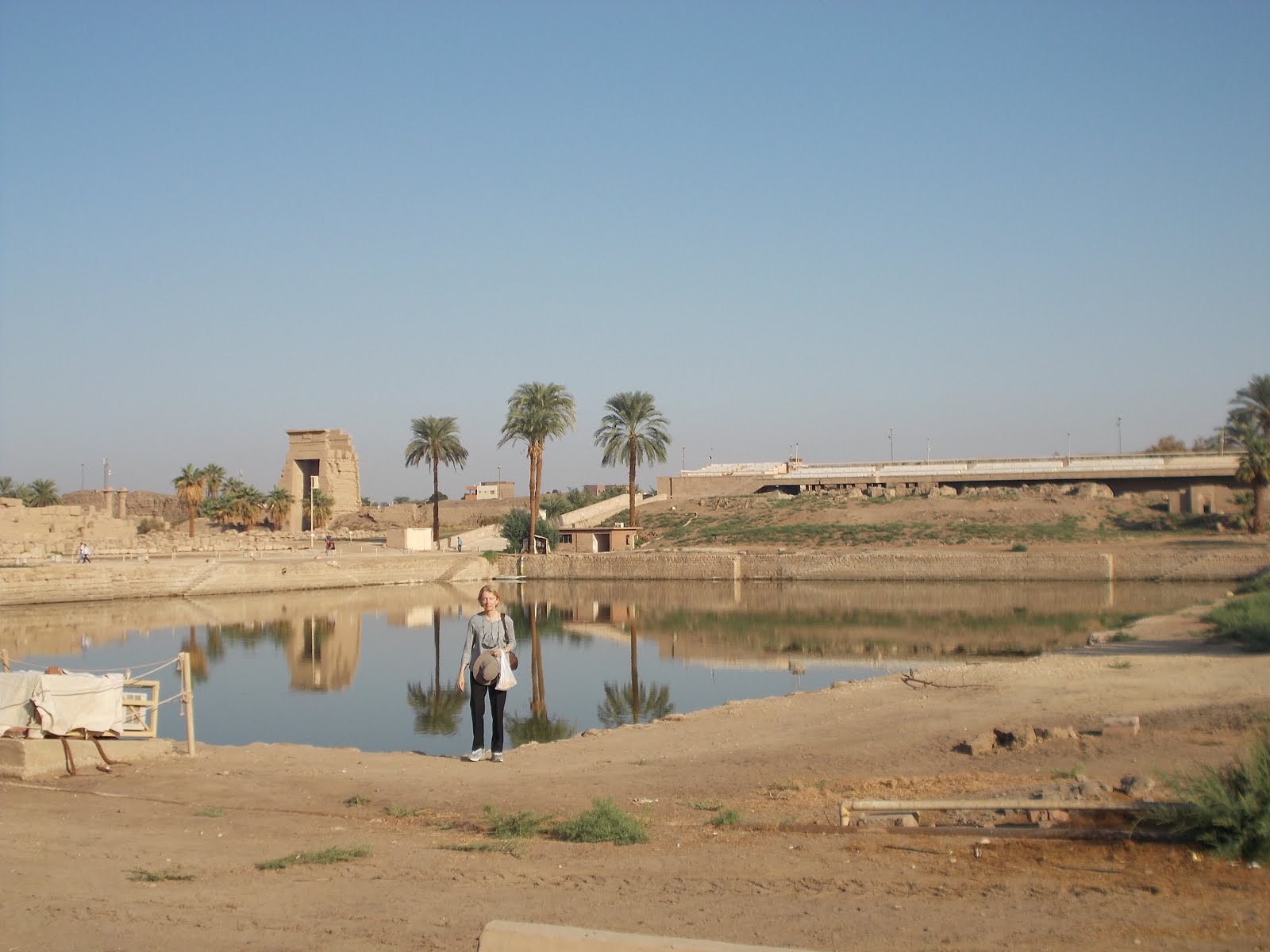
The sacred lake was used by priests to purify themselves every morning before starting their daily rituals devoted to Amun.
School girls visiting Karnak.
Friendly visitors to Karnak.
Farewell to Luxor.
And the sun sets.

Saturday, November 3, 2012

Islamists March Past Church

Salafis on the March: As Mike and I were leaving St. Andrew's Church after Bible study (Nov.2, about 1:15 PM), the large metal gates to the grounds had to be closed, since Salafis carrying flags and chanting slogans were marching past just outside on the 26th of July Street on their way to Tahrir Square. They were shouting: “The people demand the application of God’s law,” and “Islam is the solution.” The protest was organised by several Salafi Islamist groups. The debate is primarily centered on the controversial Article 2 of the draft constitution, which states that Islam is the state religion and the principles of Islamic Shari’a are the main source of legislation. Islamists demand the article be amended and the word “principles” be replaced with “rulings” or removed altogether to allow for a stricter interpretation of the text. Although Islamists dominate the Constituent Assembly, the largest represented group is the Muslim Brotherhood, which joins secular groups in that it wants to leave the article as is. Protests in Tahrir highlight divisions in society as rival factions jostle to shape the new Egypt.
Cairo's Black Cloud: The sky has been especially gray in Cairo today–probably from the burning of rice stubble. After the rice harvest each autumn, the "black cloud", a thick layer of smog from burning rice straw spreads across Cairo and the Nile valley for several weeks. This burning produces a pall of smoke that turns the capital's already noxious air into an even more toxic mix. I can certainly see it today.

Thursday, November 1, 2012

Halloween in Egypt

Nagy and Nahla Fathy: Mike and I had a wonderful visit with his internet puzzle partner in Cairo (New Maadi) and his wife. We met Nagy and Nahla at The Coffee Shop Company and had huge cups of coffee and sweets (cheesecake, cheesecake with berries, and a tort made with Mars bars). Nagy gave Mike a chess set; and they played a couple rounds which Nagy won. Nahla told me about her work as a kindergarten teacher. Though the students are still on holiday for Eid, the teachers have to go to work anyway. She teaches English and helps supervise the 4-5 yr. old pupils during the school day.
Maadi Grand Mall: After interesting conversation and learning how much my Arabic pronunciation needs improving, we took a taxi to the Maadi Grand Mall, the oldest one in Maadi. It has many floors, probably five. I needed thread and a needle, since I couldn't find any in the small shops near where I live. I found them at the mall. Then, it was to hand sanitizer at a pharmacy. And finally, we looked for towels–of Egytian cotton, of course. Three stores carried them. However, since we had just started looking for them, Mike made a waypoint for the mall on his GPS, so that we could come back, if these turned out to be the best. What fun to see all of the shops and products available in the mall.
Playing Halloween: After shopping (can you believe it after all of the coffee and sweets?), we looked for a place to eat, although it was early by Egyptian standards. We found a great fūl and ta'imiyya (falafel) restaurant, El Shabrawy. Starting with a mezza of tahina, babaganooj, salads, pickled eggplant, and Egyptian olives (which turn yellow when pickled), we each had our orders of different kinds of fūl and ta'imiyya. Fūl is an Egyptian dish of cooked and mashed fava beans served with olive oil. Other ingredients may be added: eggs, vegetables, chopped parsley, onion, garlic, and lemon juice. Mike had brought some vinyl Hex boards for Nagy, so sequences of this game were played. Then, since we had a few treats and it was Halloween, we played Halloween. Nahla and Nagy knew what it was from watching television. We improvised our masks on the spot. Nagy shaped aluminum foil; Nahla used her hijab; Mike used the cover of his King Tut book (which shows the golden funeral mask). We did talk politics. Nahla and Nagy supported the revolution but are waiting for conditions to improve. They are a charming couple.
Nahla and I playing Halloween. She was happy to get the package of Skittles (which I don't like). She used part of her hijab as as mask.
Mike as King Tut for Halloween.
Me and Mike in New Maadi. Some Egyptians think he could be a Muslim brother.
Nagy, Nahla, Carol, Mike.
Playing chess at The Coffee Shop Company café.

Tuesday, October 30, 2012

Egyptian Museum

Museum:After 43 years, I have made my second trip to the Egyptian Museum, which contains the world's most extensive collection of pharaonic antiquities.The contents of the museum date from the Prehistoric Period of Egypt to the end of the Roman era. It's always amazing. The ground floor has a massive statue pair of Amenhotep III and his wife Tiye as its focus as you enter. If you've read Naquib Mahfouz's Akhenaten, you'll know who they are–the parents of the heretic pharaoh Akhenaten (Amarna) of the 18th Dynasty (who ruled for 17 years). Akhenaten's "great king's wife" was Nefertiti; and they had six daughters. His display was great. Akhenaten raised the Aten to the position of "sole god," represented as a disk with rays of light terminating in hands which reach out to the royal family, sometimes offering the hieroglyphic sign for life. Akhenaten and his family are frequently shown worshipping the Aten or simply indulging in everyday activities beneath the disk.
Tutankhamun: The most popular of the museum’s treasures are housed in the Tutankhamun gallery on the upper floor. These fascinating artifacts (3,000 pieces) from the boy-king’s tomb were discovered by Howard Carter in 1922. These include the shrines and tomb furniture, which are definitely the main attraction of the museum. The famous gold funerary mask and coffin as well as other objects are on display elsewhere. Tutankhamun was nine years old when he became pharaoh and reigned for approximately ten years.
In historical terms, Tutankhamun's significance stems from his rejection of the radical religious innovations introduced by his predecessor and father, Akhenaten. Secondly, his tomb in the Valley of the Kings was discovered by Carter almost completely intact—the most complete ancient Egyptian royal tomb ever found. The Weight of Centuries: It's truly amazing that traces from a civilization so old survive today! The museum was filled mainly with Egyptians, of which there were many. Only a few foreign tourists were visible. The place was very warm and airless. Many objects had only numbers and no labels. Labels were hand-typed, so are quite aged. Some large statues and sarcophagi on the lower floor were still in plastic wrapping, giving the area the appearance of a storage area. Maybe all the dust and old storage areas helped me imagine the weight of centuries or millennia. The museum is open from 9 AM to 6 PM; but it's really too much to take in on one day.